
Located at the northeast corner of Coal Avenue and Walter Street in the Huning Highlands Historic District, the former Huning Highlands Conoco Service Station is representative of the “House with Bays” subtype of gas station popular in the 1930s. The building presents a cross-gable composition of two steeply pitched gabled service bays intersecting a side-gabled mass. It is constructed of glazed brick laid in a running bond pattern, and sits on a concrete foundation. The steeply pitched roof terminates with bell-cast eaves and exposed rafters. The roofing material is cement-asbestos shingle simulated as a wood grain. A corbelled brick chimney caps the roof ridge. With the exception of the removal of the gas pumps and the sign, little has changed over the years. The property retains a high degree of integrity as to the location, design, materials, workmanship and feeling of a service station during its period of significance.
As discussed in the Auto-oriented Commercial Development in Albuquerque, New Mexico, 1916-1956, the automobile played a primary role in Albuquerque’s physical and commercial development. Albuquerque historically grew along a north-south axis following the Rio Grande. Early Spanish settlement along the Camino Real was followed by the Santa Fe Railroad in 1880 and New Mexico’s first highway, NM 1, in the early teens. By the time the Continental Oil Company constructed the Huning Highlands Conoco Service Station in 1937, the city had begun to grow around a grid of primary and secondary automobile arterials. The construction of the Huning Highlands Conoco Station coincided with the realignment of U.S. 66 from the north-south Fourth Street corridor to its new east-west alignment along Central Avenue. Coal Avenue, a long thoroughfare linking the Huning Highlands to downtown Albuquerque, evolved as a prominent arterial during the 1930s, becoming an alternative route to busy U.S. 66.
With the construction of a viaduct over the Atchison, Topeka & Santa Fe Railway tracks in 1900, Coal Avenue emerged as a major east-west arterial, linking downtown Albuquerque with the newly developing East Mesa suburbs. As a result, Coal Avenue stimulated growth on both sides of the Rio Grande and figured prominently as a major arterial on city maps.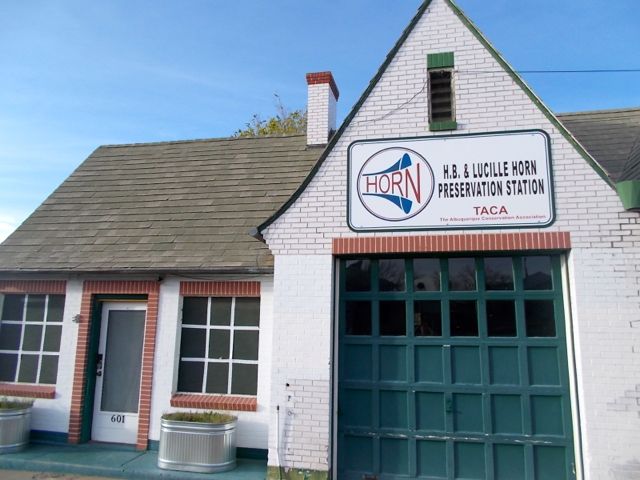
In the early 1930s, Edward and Ellen Lembke, who owned the home at 416 Walter Avenue (abutting the nominated property), owned the land on which the service station is located. Before 1936, the vacant lot served as a storage area for the Lembke Construction Co. In 1936 Lembke sold the property to Continental Oil Company (Conoco). Conoco, which strived in the 1930s to expand its territory in the Rocky Mountain states and into the Southwest, had already opened 16 service stations in Albuquerque (New Mexico Conoco Travel Guide 1933). An article in a 1937 Albuquerque Progress magazine documented the construction of the gas station and provides a photograph of how it first appeared.
Excerpts from National Register of Historic Places Registration Form.


 The Albuquerque Conservation Association