By Joe Sabatini
Part 1
When the Albuquerque Indian School (AIS) was established in 1881, it brought together students mostly from the Pueblos and other Southwestern tribes. Bringing children of different ages and tribes together in a concentrated and regimented way had an impact on the health of the school community. Contagious infectious diseases such as influenza, scarlet fever, measles and mumps could break out among students living in dormitories. Although the Indian Bureau provided medical care and vaccinations, these services were limited by low budgets.
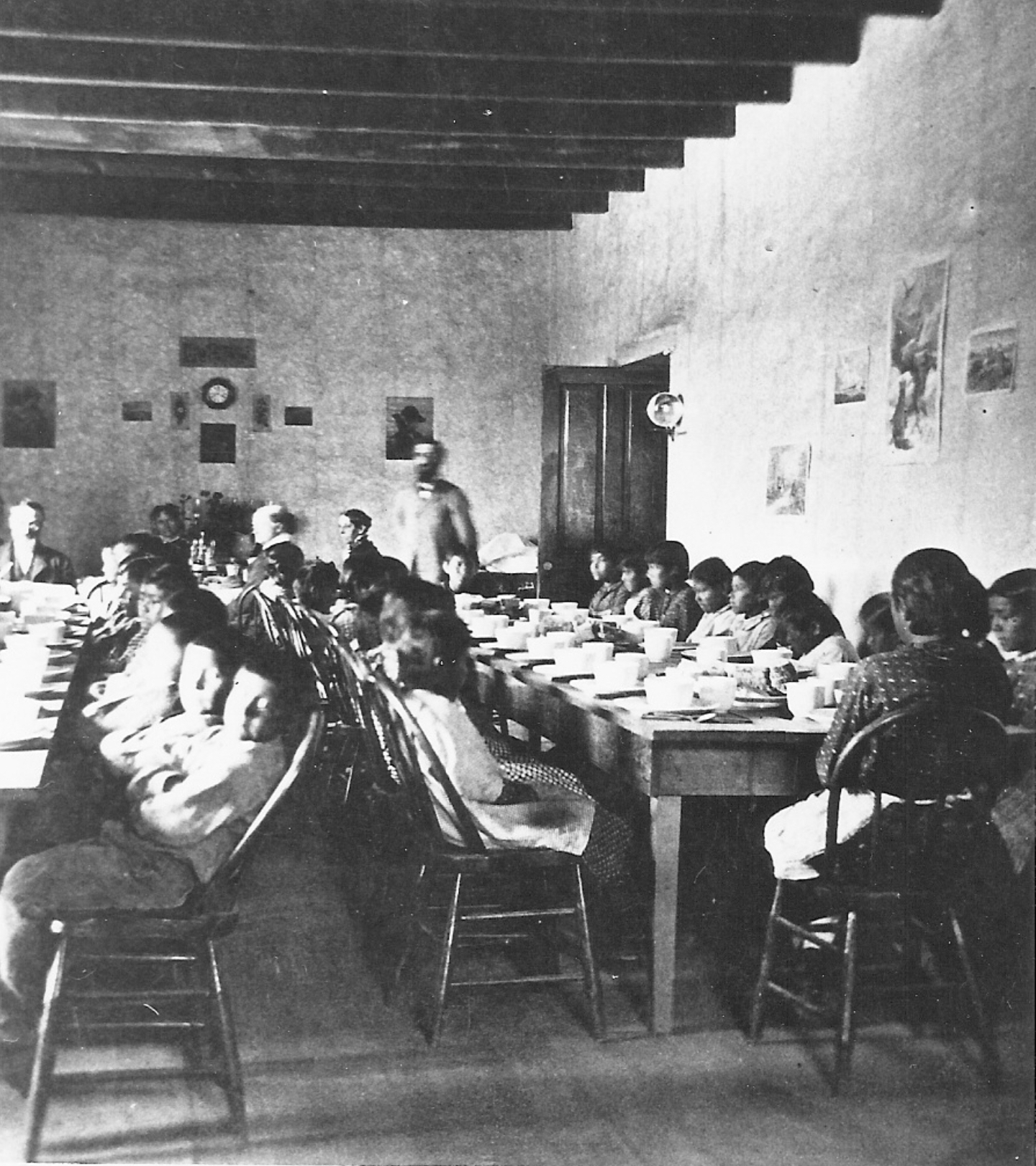
Wittick, Ben, A visit to the Indian School Dining Room at Albuquerque, New Mexico, 1880-90? Courtesy of the Palace of the Governors Photo Archives (NMHM/DCA), Ben Wittick Collection, Negative No. 086868.
Even with the establishment of an Indian hospital on the AIS campus in 1890, there were students who died from epidemic disease outbreaks. In some situations, the remains of deceased students were not returned to their home communities. A cemetery was established on school property around 1885. The best information we have is that twenty five to thirty individuals were buried therebetween 1888 and 1932. There are indications that some of the individuals buried at this Cemetery were AIS staff members or Native people who died at the AIS Hospital. There are also recorded Native American burials in a dedicated area at Historic Fairview Cemetery, some of whom were AIS students.
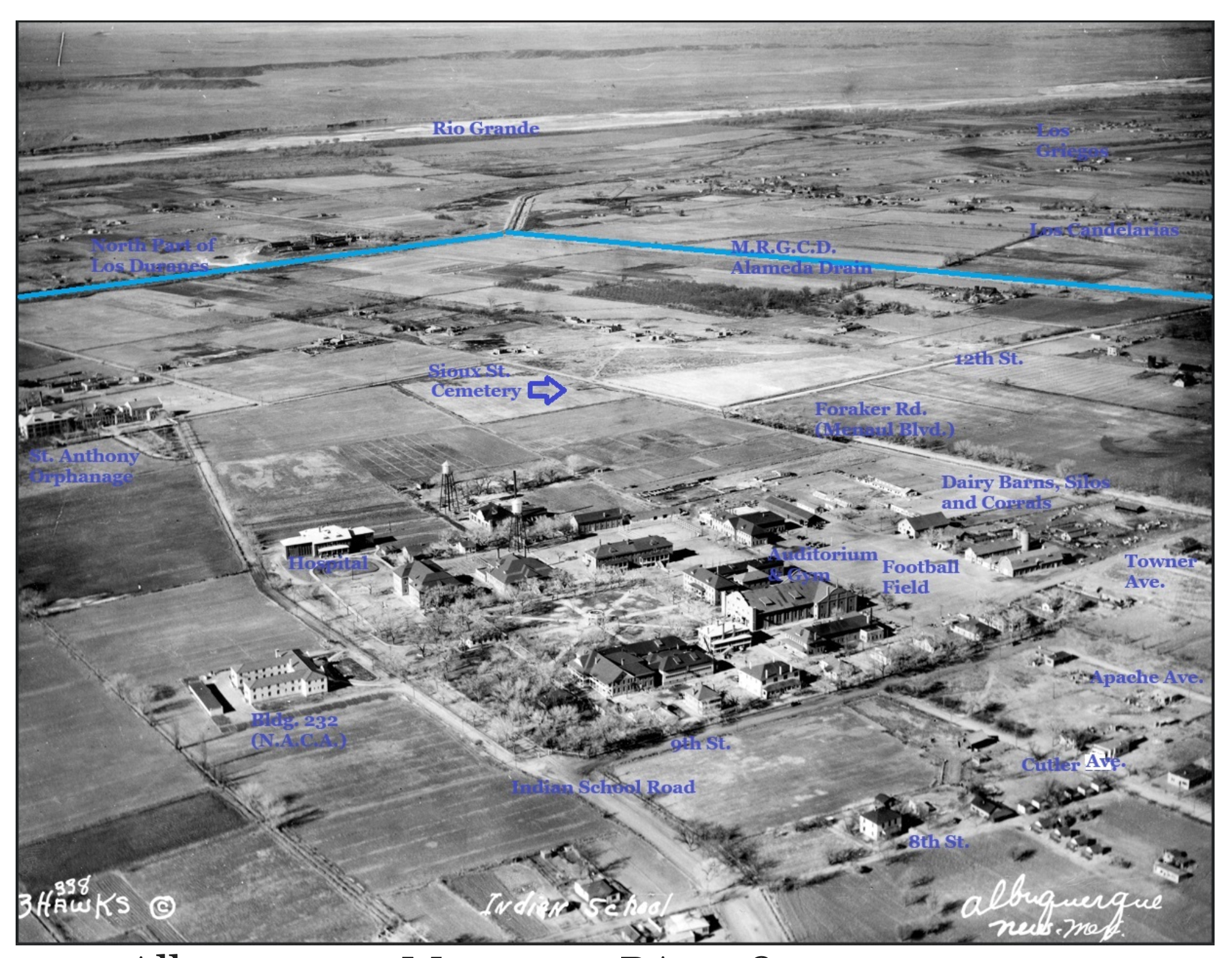
Albuquerque Museum – PA1978-141-20 ca. 1932
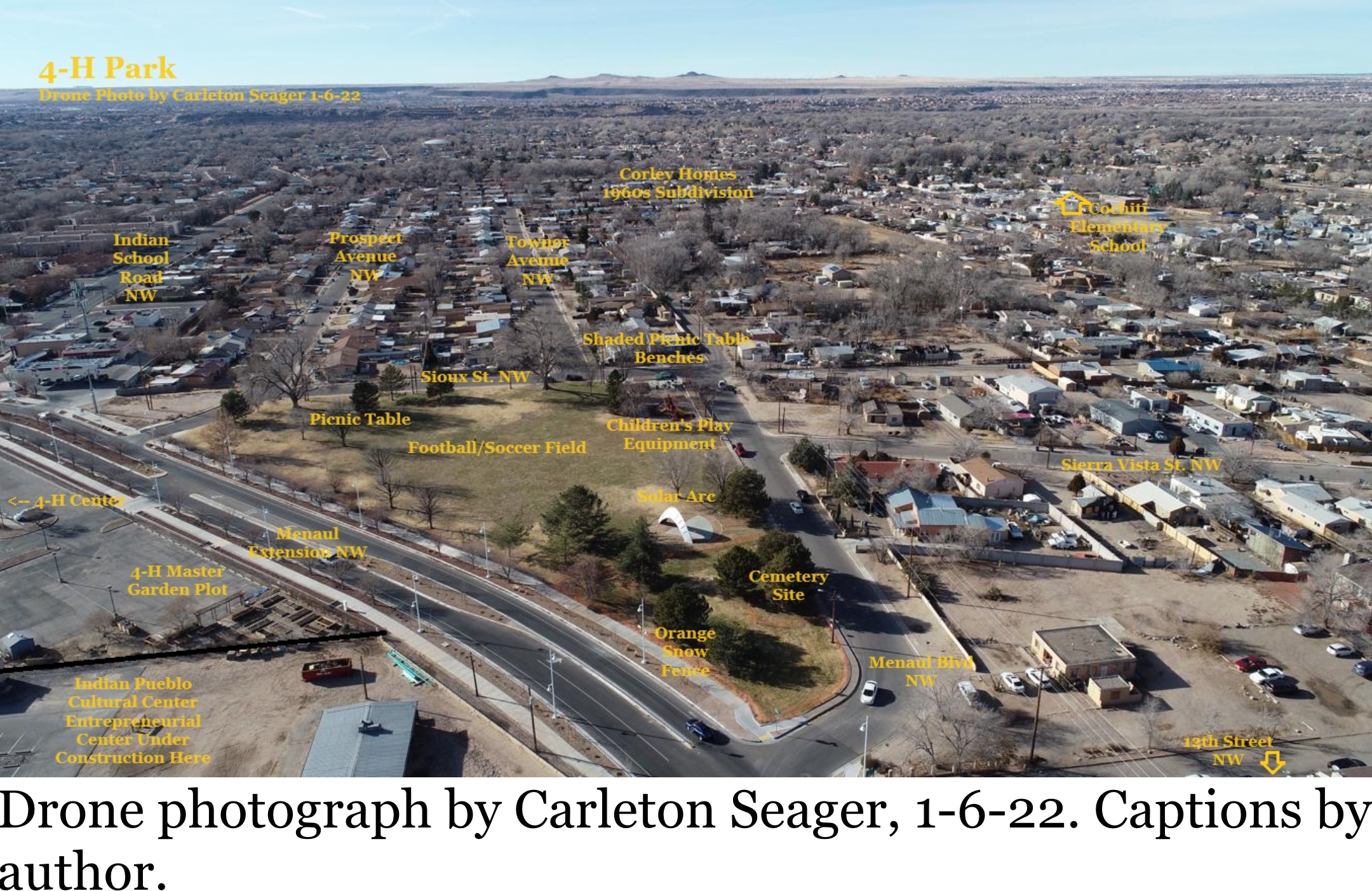
As AIS phased out its vocational agriculture programs in the late 1950s, the property west of 12th Street used for crops and grazing land was no longer needed. On April 25, 1960, the Bureau of Indian Affairs (B.I.A.) conveyed a 7-acre parcel of land to Bernalillo County, including the Cemetery grounds. The County leased part of the property to the 4-H Building Corporation, which established a 4-H Center and rodeo grounds. Other land transactions occurred in the next few years, resulting in the creation of a new diagonal street, Menaul Extension, connectingMenaul Blvd. with Indian School Road. The old route of Menaul Blvd west of 12th Street was adjusted to fork off of Menaul Extension next to the Cemetery. The City sub-leased the 2.95-acre triangular plot north of Menaul Extension from the 4-H Building Corporation on November 4, 1963, originally for a tree nursery, but ultimately for a public park they named 4-H Park.
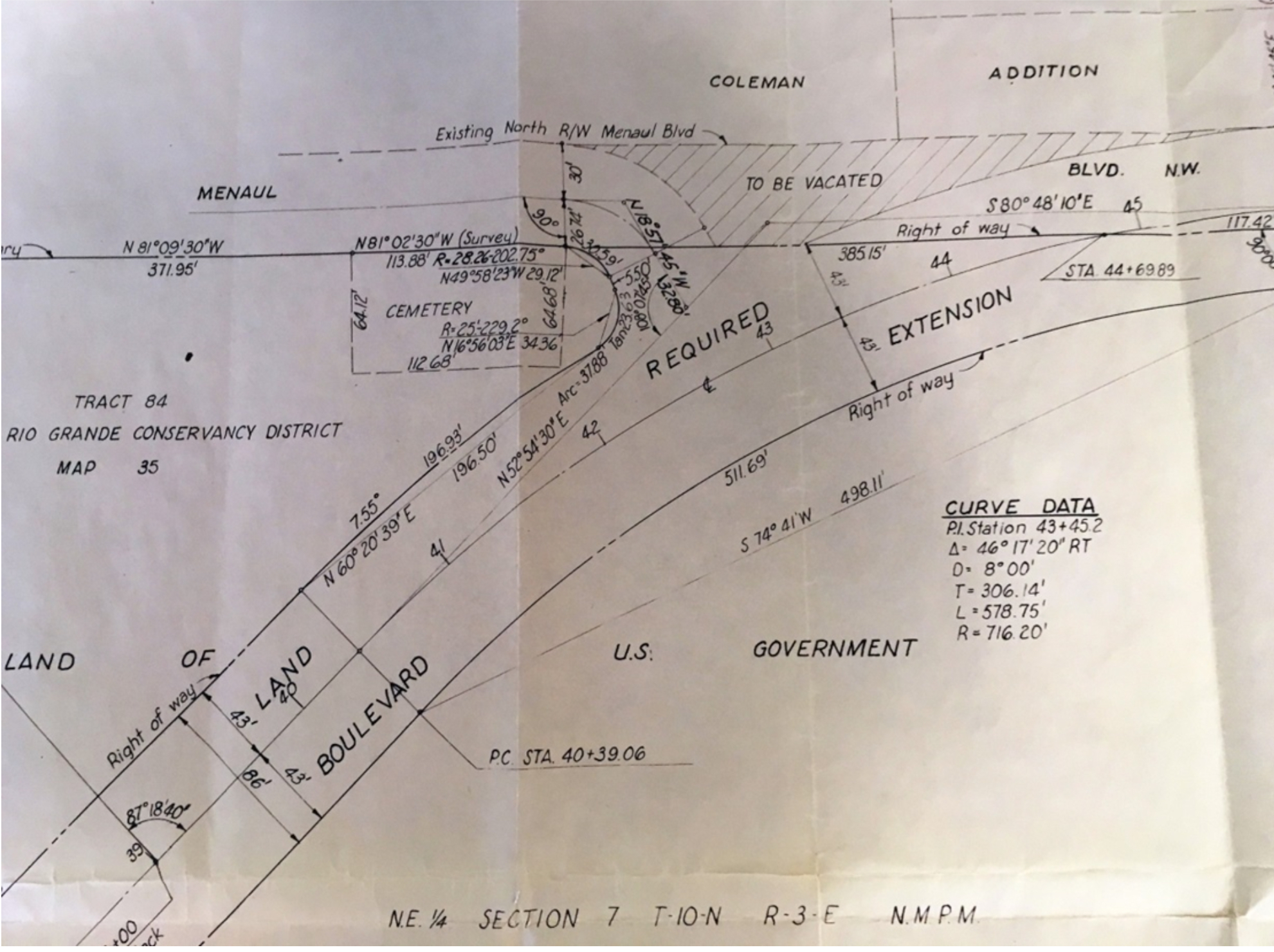
City of Albuquerque Right of Way Survey, May, 1962. In Solar Arc project files of the Public Art Urban Enhancement Division.)

In 1992, the University of New Mexico asked the City to relocate the Solar Arc, a public art sculpture at Central and Girard NE. The local neighborhood association successfully requested that it be placed in 4-H Park.During the process of relocating the Solar Arc, City officials took the Cemetery’s location into account. At the dedication ceremony in 1995, Dr. Joe Sando spoke about the Cemetery on behalf of the Indian Pueblo Cultural Center. A quotation from his remarks was included on the plaque describing and explaining the Solar Arc. “In honor of former Albuquerque Indian School students interred in the burial ground nearby. ‘Few are recalled after going to rest as these resting here. Indeed, they are in peace.’ “
When AIS was closed in 1981, the students were transferred to the Santa Fe Indian School. AIS records were placed in a basement, and many of them were damaged in a flood. There may have been records in other files that remained on the remaining campus buildings. There were no resources to protect these buildings, and several were destroyed by vagrants starting fires to keep warm in winter. In 1992, the remaining campus buildings were razed. Most of the records from the school were lost during this period. It is likely that among the lost records was any registry of the names of the individuals buried in the Cemetery.
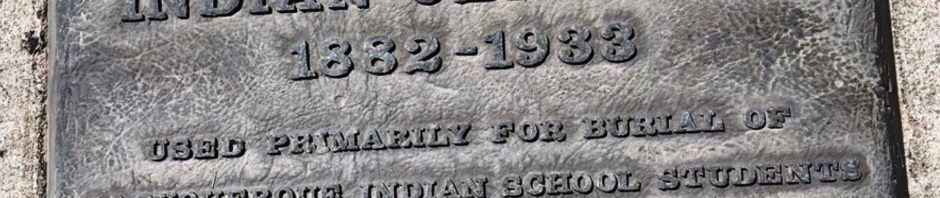
In 2019, neighbors discovered that the 1973 memorial plaque was missing. It seems highly likely that the bronze plaque was stolen for its value as scrap metal. During this period the theft of historical plaques in Albuquerque became a common occurrence.
When AIS was closed in 1981, the students were transferred to the Santa Fe Indian School. AIS records were placed in a basement, and many of them were damaged in a flood. There may have been records in other files that remained on the remaining campus buildings. There were no resources to protect these buildings, and several were destroyed by vagrants starting fires to keep warm in winter. In 1992, the remaining campus buildings were razed. Most of the records from the school were lost during this period. It is likely that among the lost records was any registry of the names of the individuals buried in the Cemetery.
Part 2.
Following revelations in June 2021 of unmarked gravesites at Indian Boarding Schools in Canada, protests and demonstrations occurred nationally about the condition of cemeteries at former Indian Boarding Schools. Native American demonstrators in Albuquerque noted that the missing plaque was typical of the dominant culture’s attempt to erase their heritage and culture. They placed ribbons, teddy bears and other children’s toys around a tree next to the missing memorial. Secretary of the Interior Deb Haaland announced a Federal Indian Boarding School Initiative, a comprehensive review of the troubled legacy of federal boarding school policies.

Photo by the author.
In response, the City of Albuquerque closed off the area around the Cemetery and initiated a public process with tribal involvement to acknowledge their responsibility for the site and to protect and commemorate the Cemetery. On September 25, 2021, Mayor Tim Keller held an AIS Cemetery Healing, Reflection and Memorial event at the Native American Community Academy, at which he apologized for the City’s treatment of the cemetery grounds. The City Council also passed a resolution of apology and commitment to do a proper memorial.
The City’s Office of Equity and Inclusion reached out to regional tribal governments seeking records about children who died while attending AIS. They sought input about the appropriate way to memorialize the cemetery. There were several public and online meetings seeking historical data and recommendations on securing and memorializing the Cemetery. The Parks and Recreation Department commissioned a survey of 4-H Park using ground penetrating radar.
The COVID-19 epidemic caused significant delays in the public process. In June, 2024 the Parks Department replaced the temporary mesh fencing enclosing the Cemetery grounds with a permanent tubular steel fence that matches the existing fencing along Menaul Extension. Community and tribal members will now have the opportunity to provide input on appropriately commemorating the century-long heritage of the Albuquerque Indian School and its Cemetery.
Additional information about the history of the Cemetery and the public memorialization process is available on the City of Albuquerque website.


 The Albuquerque Conservation Association